
How to install a JoJo Tank
If you’re looking to invest in a JoJo tank, the first question you’re probably asking yourself is: which JoJo tank should I buy?
Since each installation is different, your required water tank and size will vary depending on the water source, the desired application, the amount of available space and, of course, your personal preference. We can narrow it down by looking at your water source and intended use, and then from there, you can choose the shape and colour that you like best.
A Tank for Rainwater Harvesting?
Consider the rainfall in your area, your roof size and what the water will be used for. The biggest challenge for rainwater harvesting is accurately calculating storage capacity required. A quick calculation to use: 1mm of rain on 1mü of roof surface amounts to 1 litre of water. So, a roof area of 100m² would yield approximately 2 500 litres in a rainfall event of 25mm.
A Tank for Municipal Backup?
Take into consideration how much water you need per day (this will vary based on what the water is used for) and the period you would like the backup water to last. On average, we use 150 litres of water per person per day in SA. So a 2 500-litre tank should provide a family of four people approximately four days of municipal water backup. Try, however, to install as much capacity as you have space for and can afford.
A fully integrated system?
Consider how much municipal water you would like available and then add the amount you would like to harvest in rainwater. You will require a lot more storage capacity for this system as it behaves as both a municipal backup and a rainwater collection system.
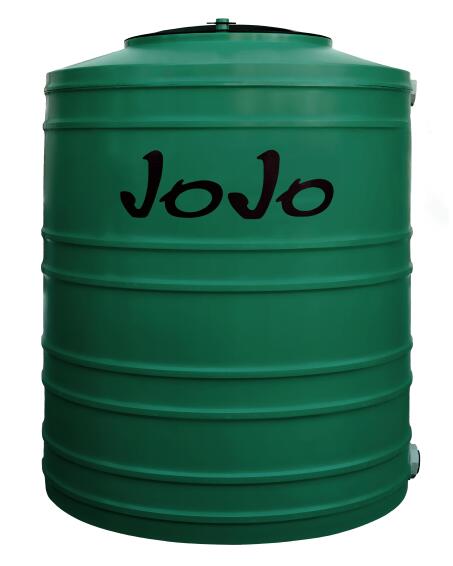
Installing the JoJo Tank
Once you’ve selected your JoJo tank, you’ll need to install it. You can either go the DIY route, or have one of our trusted installers do it all for you. If you’d prefer to handle your JoJo tank installation yourself, there are a few tips and guidelines you should keep in mind.
A water storage tank needs to be made with an additional BPA-free, food-grade black inner lining to prevent algae growth, leaching of harmful chemicals, and to protect the quality of the water stored.
One needs to ensure that their tank is installed with a suitable base. t must be a sound, level and smooth surface. Level paving will suffice, or a properly designed tank stand (with carrier beams spaced not more than 50mm apart). Alternatively, a concrete plinth needs to be built, ideally with a surface bed at least 85mm thick. Regardless of the type of foundation you choose, it should always be a minimum of 100mm wider than the diameter of the tank to avoid overhang.
To avoid unnecessary leaks, we always advise using thread tape for all connections where water is involved, even if you are only fitting a tap to an already fitted water fitting or reducer.
The material used to manufacture the tanks needs to allow for expansion/contraction in hotter and cooler weather conditions.It is important that all fittings/connections are flexible and can move with the tank instead of against it which causes friction/stress and over time could result in leaks.
An above-ground JoJo tank is not designed to handle any additional pressure. Avoid putting pressure on the roof of the tank during installation or as part of the installation (for example, downpipes resting on top of the roof of the tank) as this will cause the roof of the tank to dent or collapse. Finally also keep in mind that should this system tie into the main water supply line, there are certain plumbing laws that need to be adhered to.